Updated: 20 November 2026
Key takeaways
- A good ROAS is anything above your break-even point, which is 1 divided by your margin, so a 35% margin needs 2.86×.
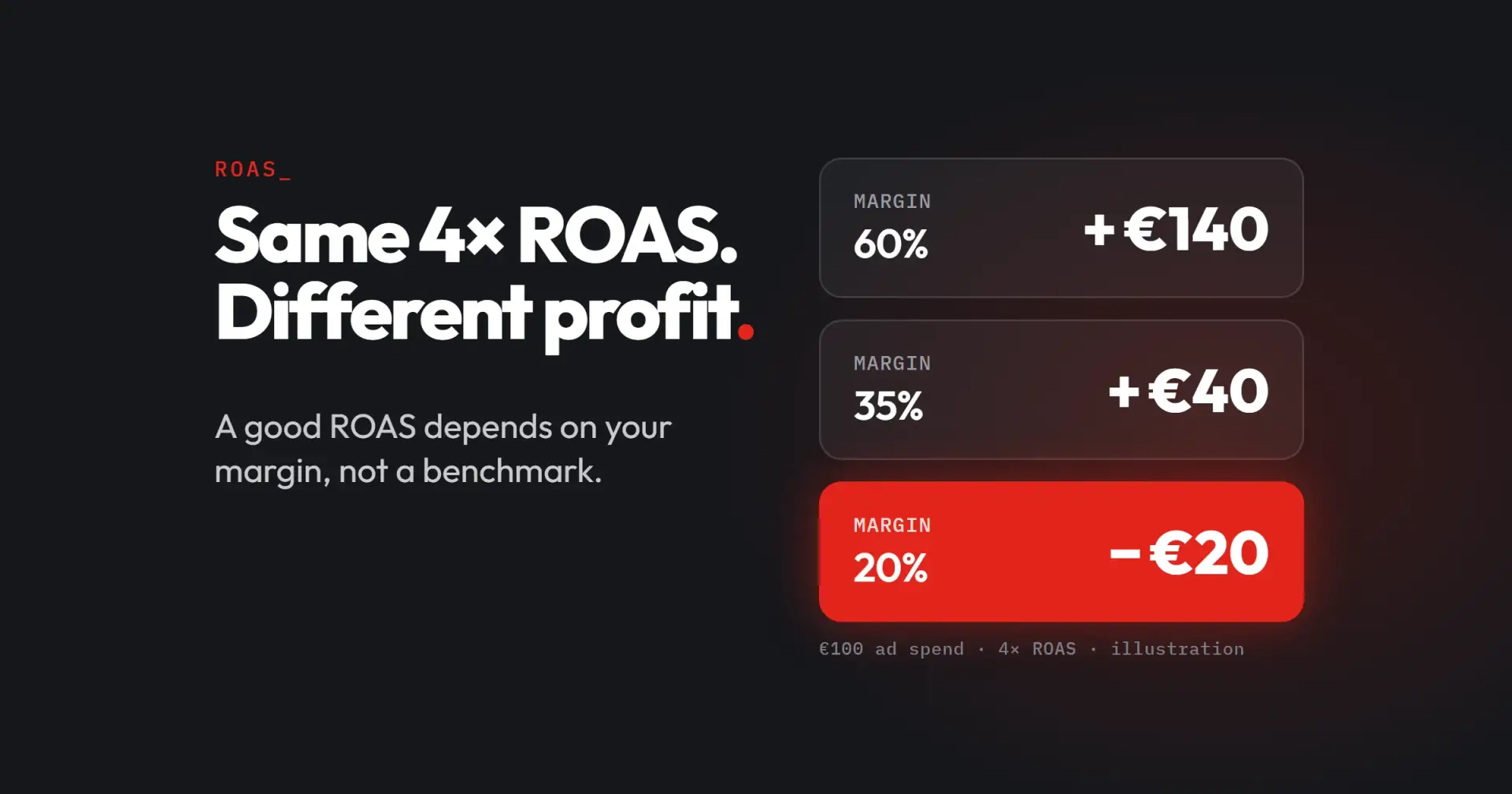
- ROAS counts revenue, not profit, so the same 4× earns €140 per €100 of ads at a 60% margin and loses €20 at 20%.
- A €100 order with €40 product cost, €6 shipping, €3 fees and €5 for returns leaves a 46% margin and a 2.17× break-even.
A good ROAS is anything above your break-even point, and that point is 1 divided by your margin. At a 35% margin you need 2.86× just to cover the cost of each order, so 2.5× loses money and 4× makes some. There is no universal good number. Benchmarks from other businesses can’t tell you whether your ads pay off. Your margin can. Our ROAS and break-even calculator gives you that number in about two minutes.
What return on ad spend measures, and what it doesn’t
ROAS (return on ad spend) is revenue from ads divided by what you spent on those ads.
ROAS = revenue from ads ÷ ad spend
Spend €1,000, get €4,000 in attributed sales, and the result is 4×, or 400% as Google Ads writes it. The ratio counts revenue, not profit. It doesn’t know what the product cost you, what you paid for shipping, how many orders came back or what discount closed the sale. That gap is where most “great ROAS, no money” stories start.
Why “aim for 4×” fails
Here is the same 4× result for three different businesses. Each spends €100 on ads and gets €400 in revenue. The only difference is the margin left after product cost, shipping, payment fees and returns. The numbers are an illustration, not client data.
| Business | Margin | Break-even | Profit at 4× (per €100 ad spend) |
|---|---|---|---|
| Digital course | 60% | 1.67× | +€140 |
| Webshop, home goods | 35% | 2.86× | +€40 |
| Webshop, electronics | 20% | 5.00× | −€20 |
Profit here is revenue × margin − ad spend. So €400 × 20% = €80, minus €100 in ads, is a €20 loss on every €100 you spend. The electronics shop sees the same 4× in its dashboard as the course creator and loses money on each order. A rule of thumb like “aim for 4×” would tell both of them they are doing fine.
Six costs your ads dashboard doesn’t show
Ads Manager and Google Ads report the sale. They don’t see what the sale cost you. Before you trust the number, take these out of the margin:
- Product cost. What you paid for the item or to make it.
- Shipping and packaging. Especially when you offer free shipping.
- Payment fees. Card, PayPal and buy-now-pay-later fees come off every order.
- Returns. A returned order can still count as revenue in the ad platform.
- Discounts. The ad platform records what the customer paid. Your margin feels the discount.
- Sales you would have had anyway. Branded search, retargeting and returning customers often get credit for orders that were already coming, so the reported figure runs higher than the real effect of the ads.
A worked example, using the same numbers as our calculator: a €100 order with €40 product cost, €6 shipping, €3 payment fees and €5 set aside for returns leaves €46, a 46% margin. Break-even is 1 ÷ 0.46 = 2.17×. If you counted only product cost (a 60% margin) you would aim for 1.67× and lose money at anything between the two.
Break-even covers the cost of each order. It does not cover rent, salaries or software. If those need to come out of ad-driven sales too, your real target sits higher.
How to find your target in three steps
- Work out your margin after variable costs. Take an average order and subtract product cost, shipping, payment fees and an allowance for returns. Divide what is left by the order value.
- Divide 1 by that margin. That is your break-even point. A 25% margin needs 4×. A 50% margin needs 2×.
- Set your target above it. Break-even is the floor, not the goal. Add room for fixed costs and the profit you want, then use that as the minimum target in Google Ads (Google calls it Target ROAS bidding) or Meta, or as the line a campaign has to clear before you raise its budget.
The free calculator does the maths with your own ad spend, revenue and margin. It also shows profit after ad spend and cost per order. Everything is calculated in your browser, and nothing is stored.
ROAS vs ROI (and where POAS and MER fit)
ROAS and ROI get used as if they meant the same thing. They don’t.
| Metric | Formula | What it tells you |
|---|---|---|
| ROAS | Revenue from ads ÷ ad spend | How much revenue each euro of ads brought in |
| ROI | (Return − cost) ÷ cost | Whether the money you put in came back with a profit |
| POAS | Gross profit from ads ÷ ad spend | Return on ad spend with the margin already applied. Above 1 means the ads pay for themselves |
| MER | Total revenue ÷ total marketing spend | The whole business view, regardless of which channel takes the credit |
Back to the home goods webshop: 4× at a 35% margin is €140 gross profit on €100 of ads. That is a POAS of 1.4 and a 40% return on the ad spend. Same campaign, three different numbers. ROAS is the one ad platforms optimise for, because it is the one they can measure. POAS and MER are the ones that match your bank account.
When a “bad” result is fine, and when a great one is a warning
Running below break-even isn’t always a problem. If customers come back and buy again, the first order can run at a loss and the second and third pay for it. That only works if you know your repeat rate, not if you hope for it. A new product or a new audience can also run below target for a short test, as long as you decide in advance how long and how much.
A very high ROAS can be a warning sign. It often means the account mostly retargets people who were already buying, or spends so little that it only reaches the easiest sales. Ask what happens if you add budget. If the extra spend stays above break-even, the high number was leaving profit on the table. Before you scale, try testing smaller audiences instead of pushing more money at the same people.
Whatever you do, track it properly. Clean UTM links keep each campaign separate in GA4, so you can compare what the platform claims with what your shop actually recorded.
Questions we get
Is a 2× ROAS good?
It is good if your margin is above 50%, because then 2× is above break-even. At a 35% margin, 2× loses money on every order.
Is a 4× ROAS good?
It makes money when your margin is above 25%. Below that, it doesn’t cover the cost of the orders.
What is a good ROAS for Facebook and Instagram ads?
The same rule applies: anything above your break-even ROAS. Meta counts conversions through its own attribution system, so check the result against orders in your shop or GA4 before you scale.
Does return on ad spend include product cost?
No. ROAS only compares ad revenue with ad spend. Product cost, shipping, fees and returns sit outside it, which is why you need the break-even number next to it.
How is break-even different from the number in my dashboard?
The dashboard number is what your ads achieved. Break-even is what they need to achieve so you don’t lose money, and it comes from your margin. Our calculator works out both.
Want someone to look at your numbers with you? Tell us about your ads and we’ll tell you honestly where they stand.